Personal Injury Attorney Denver: First Steps, Deadlines and How to Choose One
Last updated
This guide is for people hurt in Denver, Colorado, whether in a crash, a fall on someone's property or a dog attack. It covers the first steps, the records to request, the state deadlines, where a local case is filed, and how to compare personal injury attorneys. Denver has about 740,613 residents, according to the U.S. Census Bureau (2025).
Everything here is general information from Colorado statutes and official agency pages, checked November 2026. Major roads through Denver include I-25, I-70, Colfax Avenue and Colorado Boulevard.
First Steps After an Injury in Denver
What you do in the first days shapes the record of what happened.
- Get medical care and follow it. A prompt exam ties your injuries to the date of the incident.
- If a vehicle was involved, Colorado drivers must stop, help the injured and report the crash, under C.R.S. 42-4-1601, 42-4-1603 and 42-4-1606.
- If you were hurt on a property, tell the owner or manager in writing and ask that the area and any camera footage be preserved.
- Photograph the scene, the hazard and your injuries, and write down witness names.
- Keep bills, pay stubs showing missed work and a short daily note of symptoms in one folder.
Getting Police and Incident Reports in Denver
Police reports are held by the agency that responded, and each request starts with the case number.
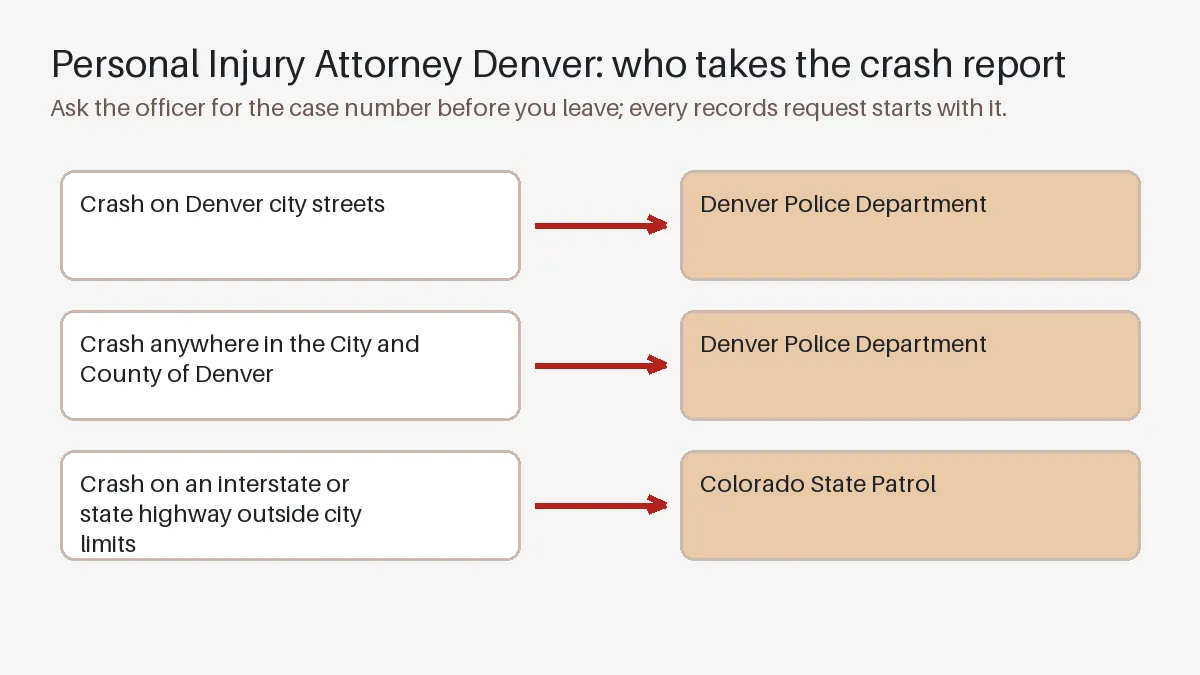
- In the city: the Denver Police Department usually takes the report; copies are requested through its records page.
- In unincorporated Denver: there are none. Denver is a consolidated city and county, so the Denver Police Department covers the whole county.
- Crashes on interstates and state highways in unincorporated areas are usually handled by the Colorado State Patrol; see its crash information page.
Colorado Deadlines and Rules for Injury Claims
- Most personal injury lawsuits must be filed within two years, under C.R.S. 13-80-102(1)(a). Injuries from operating a motor vehicle get three years, under C.R.S. 13-80-101(1)(n).
- Claims against a public entity need written notice within 182 days of discovering the injury, under C.R.S. 24-10-109.
- Shared fault: C.R.S. 13-21-111 reduces damages by your share of fault and bars recovery at 50 percent or more.
- Injuries on someone else's property are governed by the Premises Liability Act, C.R.S. 13-21-115, and serious injuries from a dog bite by C.R.S. 13-21-124.
Where Denver Injury Cases Are Filed
Injury lawsuits from Denver are generally filed in the Denver District Court, part of Colorado's 2nd Judicial District, at 1437 Bannock Street, Denver, CO 80202 (Denver City & County Building, civil matters). Smaller claims can be filed in county court, and most injury claims settle before trial.
Local Injury Data
63 people died in motor vehicle traffic crashes in Denver County in 2024, according to the federal Fatality Analysis Reporting System. The figure covers the whole county and every type of road.
How to Choose a Personal Injury Attorney in Denver
- Verify the license in the Colorado attorney search from the Office of Attorney Regulation Counsel, and check for public discipline.
- Ask how many cases like yours the attorney has handled and how many went to trial.
- Get any contingency fee in a signed writing, as Rule 1.5(c) of the Colorado Rules of Professional Conduct requires, and ask how costs are charged.
- Be cautious about uninvited contact after an injury. C.R.S. 13-93-111 bars soliciting an injured person within 30 days of the incident.